From Entrepreneurial Interest to Long-Term Engagement

Three Keys to More Effective Recruiting in Direct Selling
By Gordon D. Hester
Over more than three decades in direct selling, I have watched the industry adapt to major changes in technology, consumer behavior, regulation, communication, and the way people think about work. Recruiting has remained fundamental throughout those changes. What has changed is the environment in which companies and distributors now compete.
Today’s prospective business builders have more choices than ever. Freelancing, e-commerce, consulting, coaching, creator businesses, platform-based work, and other side-income models all compete for their attention. Digital platforms also make it easier to research opportunities, compare experiences, and form an opinion before ever speaking with a company or distributor.
Direct selling still offers meaningful advantages: accessible entry, established products and services, flexible participation, personal development, relationships, and the opportunity to earn additional income. However, those advantages are no longer enough by themselves. The industry must earn consideration by demonstrating that its opportunity is relevant, credible, and supported by an experience that helps people make progress.
Effective recruiting is not enrollment. It is the alignment of fit, expectations, support, and experience.
An Entrepreneurial Moment — and a Competitive Challenge
Interest in entrepreneurship is significant. The Global Entrepreneurship Monitor reported that 19% of U.S. adults were engaged in early-stage entrepreneurial activity in its 2024-2025 assessment. The U.S. Small Business Administration reported 36.2 million small businesses employing 62.3 million people in 2025.
These figures do not prove that people are specifically looking for a direct-selling opportunity. They do show that a substantial audience values flexibility, ownership, independence, and the ability to create income on different terms. That creates a potential recruiting audience—but direct selling must still demonstrate why its model is relevant and competitive.
Industry participation data makes the challenge clear. The number of U.S. direct sellers reached 7.7 million during the exceptional pandemic environment of 2020. By 2024, participation had declined to 5.4 million—a decrease of approximately 30% from the peak.
I do not view this only as negative news. I view it as a call to modernize how the industry identifies, recruits, onboards, activates, and supports business builders. A prospective distributor should not be sold a dream. That person should be given a realistic opportunity, a clear pathway, and the support needed to develop productive behaviors over time.
Three Keys to More Effective Recruiting
A sustainable recruiting strategy should address three responsibilities:
- Recruit the right business builders.
- Provide a credible pathway to progress.
- Create experiences that build advocates rather than detractors.
These responsibilities are shared by corporate executives and the field. Companies design the environment, products, policies, systems, tools, and support. Field leaders bring the opportunity to life through relationships, example, coaching, and consistent behavior.
KEY 1
Recruit for Fit, Not Pressure
Effective recruiting begins with clarity about the person most likely to benefit from—and contribute to—the business. The right business builder should not be defined only by age, gender, profession, or another demographic label. A more useful profile considers motivation, behavior, readiness, and alignment with the actual work required.
I think of the high-potential builder as a purpose-driven progress seeker: someone who wants greater flexibility or additional income, values relationships, is willing to learn, and is prepared to take consistent action. This is an illustrative profile, not a universal industry avatar. Every company should validate its target profile using the experiences of distributors who become active, productive, and retained.
Common indicators of fit may include:
- A realistic reason for wanting additional income or greater flexibility.
- A genuine connection to the company’s products, services, or customer community.
- A willingness to learn customer acquisition, communication, and business skills.
- Relational strengths, coachability, consistency, and a service-oriented mindset.
- An interest in long-term development rather than immediate or guaranteed results.
Recruiting for fit requires mutual qualification. The purpose of the conversation is not to convince every prospect to join. It is to determine whether the opportunity, expectations, and working relationship make sense for both sides.
Companies should also analyze recruiting results by source, message, sponsor, and prospect profile. Gross enrollment may show activity, but it does not show recruiting quality. The more important question is which recruits become customers, active distributors, capable business builders, and trusted advocates.
KEY 2
Provide a Credible Pathway to Progress
Recruiting is only the beginning. The quality of the experience after enrollment determines whether a new distributor becomes engaged, productive, and confident.
One of the most important principles in any relationship-based business is that disappointment often begins with unmet expectations. When people are offered hope without a practical pathway for turning that hope into progress, trust declines. Over time, that loss of trust affects engagement, customer retention, confidence in leadership, and belief in the business model.
Set Honest Expectations
Before joining, prospective distributors should understand:
- What the business requires and how customers are acquired.
- How compensation is generated and why individual results vary.
- Which skills they will need to develop.
- How much time consistent activity may require.
- What support is available and what early progress realistically looks like.
Honest expectations do not weaken recruiting. They improve the quality of the decision and establish a healthier foundation for the relationship.
Simplify the First Steps
New distributors are frequently overwhelmed by too much information, too many tools, and too many competing priorities. A more effective onboarding process concentrates first on a small number of productive behaviors:
- Develop confidence in the products or services.
- Identify a realistic customer audience.
- Learn how to begin authentic conversations.
- Acquire and serve initial customers.
- Establish a consistent weekly activity rhythm.
- Connect with a coach, leader, or peer community.
- Review progress and adjust the plan.
The objective is not to teach the entire business immediately. It is to help the new distributor experience early clarity, competence, and progress.
Measure Progress Beyond Enrollment
Enrollment is not evidence of recruiting success. Companies should measure whether new distributors complete onboarding, connect with support, acquire customers, establish productive habits, and remain engaged.
Useful indicators include time to first customer, seven- and 30-day activation, onboarding completion, sponsor contact, 90- and 180-day retention, and documented reasons for disengagement. Churn should not be treated merely as an administrative measurement. It is a signal about the quality of the recruiting, customer, distributor, and leadership experience.
Long-term growth depends on the health of the broad base of customers, affiliates, new distributors, and developing leaders. Sustainable growth is created by strengthening that base—not only by celebrating the top.
Recruitment may create initial hope, but onboarding must confirm that hope through real experiences. Clear first steps, customer-acquisition support, skill development, recognition, and consistent coaching help people determine whether the opportunity is credible and achievable for them.
KEY 3
Create Advocates, Not Detractors
Every interaction contributes to the reputation of the company, the distributor, and the direct-selling profession. Over time, those interactions tend to create three broad groups: advocates, neutral participants, and detractors.
Advocates
Advocates trust the company, use and recommend its products, participate in its systems, and are willing to align part of their personal reputation with the organization. They can become an important source of referrals, customer loyalty, recruiting, leadership, and marketplace credibility. Advocates are not created by messaging alone. They are created by consistently positive experiences.
Neutral Participants
Neutral participants may remain connected to the business but have lost confidence or enthusiasm. They may still value certain products, relationships, or income, yet no longer feel fully engaged. This group deserves attention because listening, transparency, and meaningful support may restore trust and participation.
Detractors
Detractors often emerge when there is a significant gap between what people were led to expect and what they actually experienced. Their feedback may reveal weaknesses in recruiting claims, onboarding, communication, policy application, leadership behavior, customer experience, or the way departures are handled.
Companies and field leaders can reduce the creation of detractors by:
- Setting realistic expectations.
- Communicating changes transparently.
- Applying policies consistently.
- Making income and product claims responsibly.
- Responding to concerns respectfully and resolving conflicts fairly.
- Treating people with dignity when they decide to leave.
Trust Is the Foundation
Prospective distributors ask several questions, even when they do not state them directly:
- Is this opportunity credible?
- Are the people presenting it trustworthy?
- Will the company do what it says?
- Will I receive support after I join?
- Are the income expectations realistic?
- Will I be respected if I decide this is not for me?
Companies answer these questions through their products, compensation structure, technology, policies, communication, and field culture. Distributors answer them through their language, conduct, follow-through, and willingness to put the other person’s interests ahead of a quick enrollment. Trust grows when expectations and experiences remain aligned.
A Shared Responsibility
Recruiting is not solely a field activity, and it is not solely a corporate initiative. Companies create the environment, tools, policies, support, and value proposition. Field leaders determine how the opportunity is presented and experienced in practice. The strongest results occur when corporate strategy and field behavior reinforce one another.
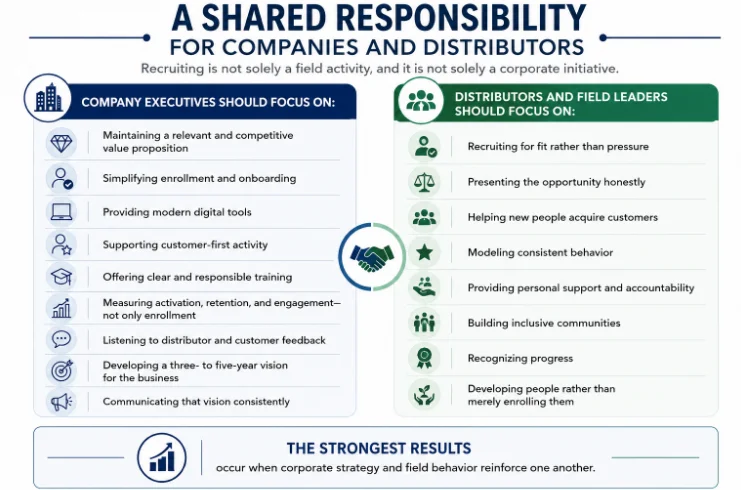
Corporate systems and field behavior must reinforce one another.
Strong field leaders will struggle inside a weak or inconsistent company system. Strong corporate systems will also underperform if field behavior creates pressure, confusion, or unrealistic expectations. Recruiting effectiveness must therefore be evaluated across the complete journey—from market positioning and the first message through enrollment, activation, retention, and advocacy.
Questions Every Company Should Ask
A useful recruiting review should move beyond opinions and examine evidence. At a minimum, company executives and field leaders should be able to answer the following questions:
- Who are our most active and retained business builders, and what attracted them?
- Is our opportunity clearly differentiated from other flexible-income and entrepreneurial options?
- Where do qualified prospects disengage from the recruiting and enrollment process?
- How quickly do new distributors acquire a customer and begin productive activity?
- What percentage remain engaged after 90 and 180 days, and why do others leave?
- Are corporate messages, field practices, and the actual distributor experience aligned?
The answers should combine recruiting-funnel data, cohort retention, message and process audits, and feedback from corporate teams, field leaders, new distributors, active distributors, and people who have left. An executive self-assessment alone will produce an incomplete picture. The real value comes from comparing leadership perceptions with operational data and the lived experience of participants.
Reframing Recruiting Positively
Recruiting has acquired negative associations in parts of the direct-selling marketplace. That does not mean the industry should avoid the subject. It means the industry should define and practice recruiting more responsibly.
At its best, recruiting is not about convincing someone to join. It is about introducing a relevant opportunity, determining mutual fit, and helping a person make an informed decision. Responsible recruiting creates clarity rather than confusion, realistic hope rather than hype, development rather than dependency, and long-term engagement rather than short-term activity.
Conclusion
Direct selling has meaningful advantages in an economy increasingly shaped by flexible work, digital commerce, entrepreneurship, and community. However, the industry cannot rely on accessibility and income potential alone.
The next stage of growth will not come from louder promises or more aggressive recruiting. It will come from greater relevance, clearer expectations, simpler systems, stronger customer acquisition, healthier culture, and more consistent support.
Sustainable recruiting requires a stronger match between the people being recruited, the expectations being established, and the experience delivered after enrollment. When companies and field leaders recruit for fit, provide a credible pathway to progress, and consistently earn trust, recruiting becomes more than enrollment. It becomes the beginning of a productive, long-term relationship.
About Gordon Hester
With over 35 years of experience in sales, operations, and leadership, Gordon Hester is recognized as one of the foremost strategic thinkers in the direct selling industry. Having served as CEO, CIO, and CSO, Gordon brings a rare 360-degree perspective to business development and organizational growth.
As the former CEO of Roberti Enterprises, he led one of the largest global distributorships in industry history — exceeding $8 billion in sales and 100,000 distributors across 25 countries. Today, Gordon leads Hester Consulting Group, and Shapetech Solutions, a Sarasota- and Serbia-based tech firm that provides transformative digital solutions to global businesses. Gordon is also Founder & Executive Chairman of the Florida Direct Sellers & Consumers Coalition (FLDSCC), a 501(c)(4) advocacy organization dedicated to protecting and strengthening the direct selling channel in Florida.
A member of multiple industry advisory boards, including the Direct Selling Association, the Direct Selling Education Foundation, and ANMP, Gordon also serves on the Make-A-Wish Foundation board and the Entrepreneurial Program Advisory Council at Wake Forest University.
He is the author of Positioned Right and a frequent Forbes contributor, known for his commitment to ethical leadership, innovation, and advancing the future of direct selling.
Sources
- Global Entrepreneurship Monitor, 2024-2025 USA National Report
- U.S. Small Business Administration, 2025 United States Small Business Profile
- Direct Selling Association, 2020 Industry Overview
- Direct Selling Association / Direct Selling Education Foundation, 2024 Industry Overview
Disclaimer: At BFH, we strive to keep all content—articles, press releases, data—as accurate and current as possible at time of publishing. However, treat this content as a guide, not as definitive authority for business decisions. Publishing a press release does not imply Business For Home BV endorses a company or individual, nor guarantees its claims. No warranties or representations, expressed or implied, are made regarding the accuracy, completeness, or suitability of information provided on this website. All content is provided “as-is,” without liability for errors or usage. Always fact-check and conduct your own due diligence. BFH publishes press releases for the global Direct Selling / Network Marketing / Home Business community. Laws governing Direct Selling can vary greatly by country; BFH does not warrant that any company or content is in full compliance with various local or country-specific laws; it’s up to the reader to research, verify and comply with all applicable local regulations.